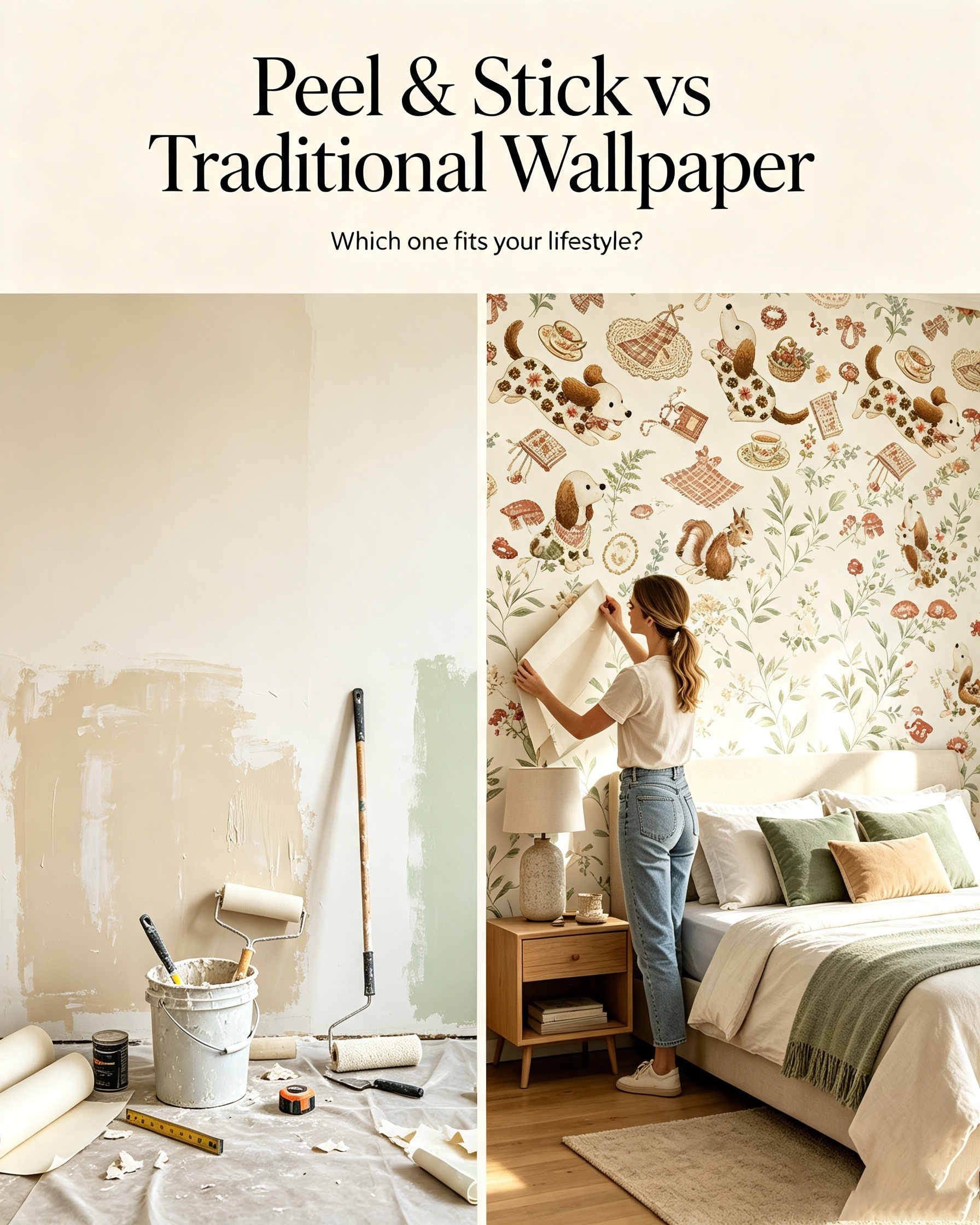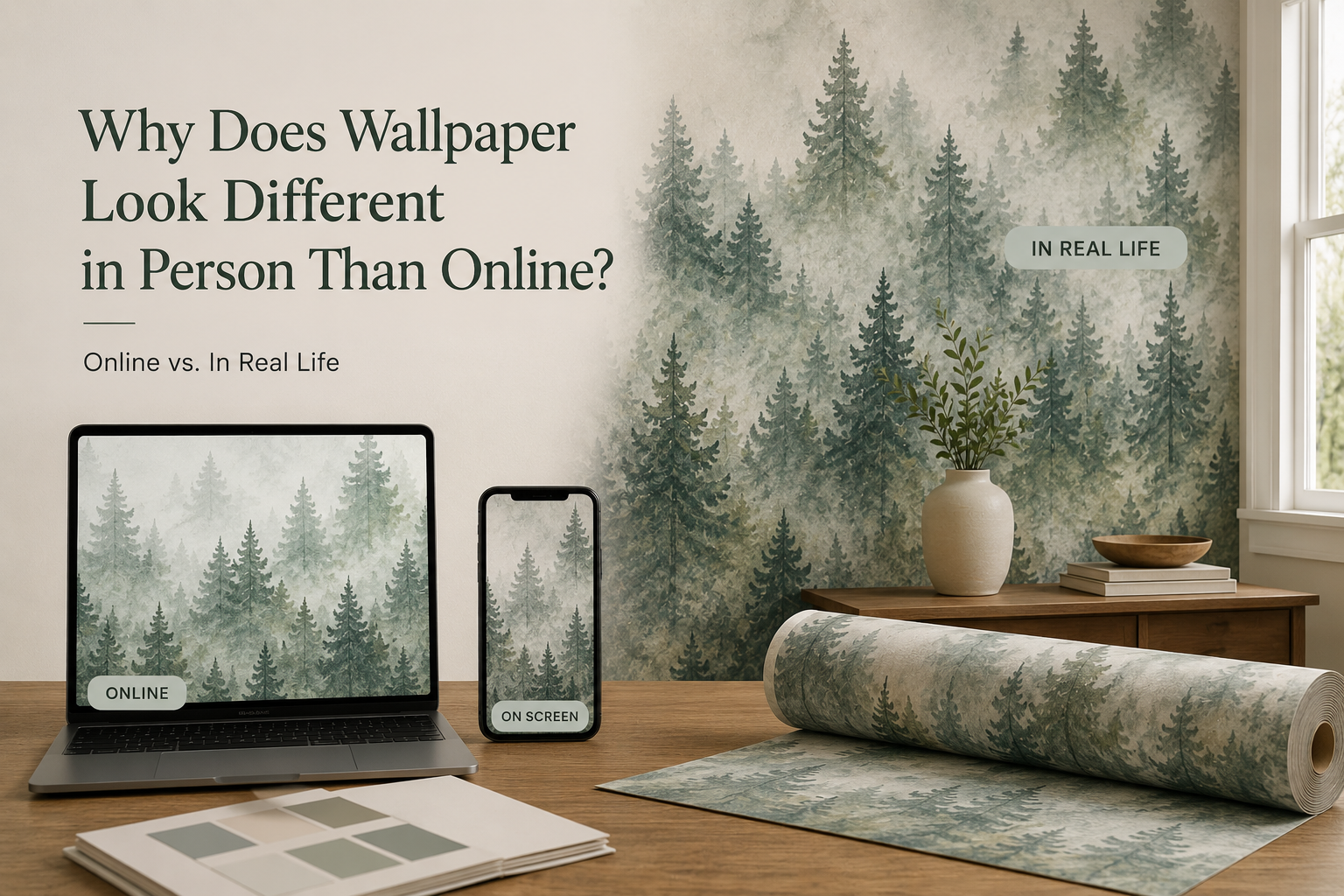

Choosing wallpaper is rarely just about finding a pattern you love.
A wallpaper that looks beautiful in a showroom or online may feel completely different once it covers your own walls. The reason is simple: pattern scale, room size, ceiling height, furniture, and the amount of visual detail in a space all affect how wallpaper feels.
So instead of asking, “Is this wallpaper beautiful?”, a better question is:
“Is this the right pattern for my room?”
This wallpaper pattern decision guide will help you answer that question before you buy.
Quick Answer: How Do You Choose the Right Wallpaper Pattern?
Start with the room rather than the wallpaper.
- Small room: Consider small-scale or low-contrast patterns that feel lighter and less visually crowded.
- Low ceiling: Vertical or upward-moving patterns can help create a sense of height.
- Large room: Medium- to large-scale patterns can prevent the walls from feeling visually empty.
- Minimalist interior: Subtle geometric or restrained patterns usually work well with simple furniture.
- Cottage-style room: Botanical, floral, and illustrated patterns can reinforce a warm, collected feeling.
- Want a focal wall? A larger or bolder pattern can create a stronger visual anchor.
The goal is not to find the “best” wallpaper pattern. It is to find the pattern whose scale and visual weight make sense for the space.
1. Does Room Size Matter When Choosing Wallpaper?
Yes—but room size doesn't mean you have to follow a strict rule such as “small rooms need small patterns.”
The more useful question is how much visual weight the pattern adds to the room.
For small rooms
Large, dense patterns can sometimes make a compact room feel more visually active. That doesn't mean you should avoid them completely. Instead, consider patterns with:
- Smaller motifs
- More breathing room between elements
- Lower contrast
- A lighter visual rhythm
These characteristics can help the walls feel less overwhelming.
However, a small room can also handle a bold pattern when the rest of the space is relatively simple. A dramatic wallpaper on one wall may actually give a small room more personality than covering it with several competing design elements.
For large rooms
Large rooms generally have more visual space to absorb a substantial pattern.
Medium- or large-scale florals, botanicals, oversized illustrations, and geometric designs can help prevent a large wall from feeling empty or unfinished.
The key is proportion.
A large wall can usually carry more pattern than a small wall.
2. How Does Pattern Scale Affect a Room?
Pattern scale refers to the size of the individual elements within a wallpaper design.
Think of the difference between:
- Tiny repeating leaves
- Medium-sized flowers
- Large botanical branches
- Oversized geometric shapes
They may use similar colors, but they create very different visual impressions.
Small-scale patterns
Small patterns create a more consistent texture across the wall. They can be useful when you want the wallpaper to feel subtle rather than become the main focal point.
Medium-scale patterns
Medium patterns often provide a balance between personality and visual calm. They work well in bedrooms, living rooms, dining spaces, and other rooms where you want the wallpaper to be noticeable without dominating the entire design.
Large-scale patterns
Large patterns make a stronger statement.
They can be especially effective when you want the wall itself to become part of the room's architecture or create a clear focal point.
But large patterns deserve more consideration before installation. Look at how the design will be cropped around windows, doors, furniture, and corners—not just how the full pattern looks in a product image.
3. What If My Room Has Low Ceilings?
When a room has a low ceiling, consider how the pattern moves across the wall.
Vertical lines, elongated botanical elements, and upward-moving designs can create a visual impression of greater height.
The effect doesn't physically change the ceiling height. Instead, the direction of the pattern can influence how the eye moves through the space.
For example, a botanical design with stems extending upward can feel more vertical than a pattern made of evenly distributed horizontal elements.
If your goal is to make the room feel taller, avoid choosing a pattern solely because it looks good in a flat product image. Consider its direction and rhythm across the entire wall.
4. Should Wallpaper Match Your Furniture?
Not exactly.
In fact, trying to match your wallpaper perfectly to your furniture can make a room feel overly coordinated.
A better approach is to look for visual relationships.
Your wallpaper can connect with the room through:
- A similar color family
- Repeated natural tones
- Complementary contrast
- Similar design character
- Shared traditional or modern influences
For example, a botanical wallpaper doesn't need to contain the exact green used on your sofa.
Instead, the greens, creams, browns, or muted tones in the wallpaper might quietly connect with the furniture and flooring.
Think coordinate, not copy.
5. How Much Pattern Is Too Much?
There isn't a universal rule.
The question is whether the room already contains several competing visual elements.
A room with:
- Patterned curtains
- A highly detailed rug
- Decorative furniture
- Artwork
- Multiple accent colors
may need a quieter wallpaper.
On the other hand, a room with simple furniture, neutral flooring, and minimal decoration can often handle a much stronger wallpaper pattern.
This is especially important with floral, botanical, and vintage-inspired wallpapers.
These designs can contain many visual elements, even when their colors are soft.
If the wallpaper is already detailed, let some other parts of the room remain quiet.
The more visual information your wallpaper provides, the less the rest of the room needs to compete with it.
6. Should You Use a Bold Wallpaper on Every Wall?
Not necessarily.
There are two common approaches.
Use bold wallpaper on one wall
An accent wall works particularly well when you want to:
- Highlight a bed
- Frame a dining area
- Create a reading corner
- Emphasize a fireplace
- Define a small feature area
A bold pattern can become the room's visual anchor without competing with everything else.
Use wallpaper throughout the room
Full-room wallpaper can work beautifully when the pattern is relatively balanced with the room's size and furnishings.
Subtle botanicals, small-scale florals, quiet geometrics, and low-contrast patterns are often easier to use across multiple walls.
But don't assume that bold wallpaper must always be limited to one wall.
If the room is large enough and the rest of the design is restrained, a dramatic pattern can work across all four walls and create a much more immersive interior.
The real question is:
Can the room support the visual weight of the pattern?
7. What Wallpaper Patterns Work Best for Small Rooms?
If you want a simple starting point, look for patterns that don't create excessive visual weight.
Good options can include:
Small-scale botanical patterns
They add detail without making each individual motif feel oversized.
Low-contrast floral patterns
These can bring softness and character while keeping the overall wall relatively calm.
Subtle geometric patterns
Simple lines and repeated shapes can add structure without overwhelming a compact space.
Light, open patterns
Designs with more breathing room between motifs can feel less dense than tightly packed patterns.
That said, there is no wallpaper pattern that is universally “right” for every small room.
A small room with simple furniture may look fantastic with a dramatic oversized floral. The important thing is to consider the entire composition rather than following a single decorating rule.
8. Quick Wallpaper Pattern Decision Chart
| Your Room or Goal | Recommended Pattern Direction |
|---|---|
| Small room | Small-scale or low-contrast patterns |
| Low ceiling | Vertical or upward-moving patterns |
| Large room | Medium- to large-scale patterns |
| Minimalist interior | Subtle geometric or restrained patterns |
| Cottage-style room | Botanical, floral, or illustrated patterns |
| Want a focal wall | Larger or bolder patterns |
| Busy furniture and décor | Quieter, lower-contrast patterns |
| Simple furniture and neutral décor | Stronger patterns can work well |
Use this chart as a starting point—not a strict rulebook.
The best wallpaper is the one that creates the right balance between the pattern and everything around it.
Choose the Pattern for the Room, Not Just the Wall
The most beautiful wallpaper isn't necessarily the one with the most impressive pattern.
It is the one that feels right once everything else is in the room.
Before choosing, step back and consider:
How large is the room?
How tall are the ceilings?
How much visual detail is already there?
What furniture will sit in front of the wallpaper?
Do you want the wallpaper to quietly support the room—or become the main character?
Once you start looking at wallpaper through those questions, choosing a pattern becomes much easier.
Don't just choose a wallpaper you love. Choose a pattern your room can love, too